Offshore Bookkeepers guide

Build a journal-entry support index reviewers can use

Create a journal index that connects each non-routine entry to its purpose, calculation, evidence, approval, posting, and reversal.

Create a journal index that connects each non-routine entry to its purpose, calculation, evidence, approval, posting, and reversal.

The short answer

  • Use one immutable reference to connect the request, support, approval, posted journal, and any reversal.
  • Reconcile indexed entries to the ledger and investigate missing, duplicate, changed, or late-posted items.
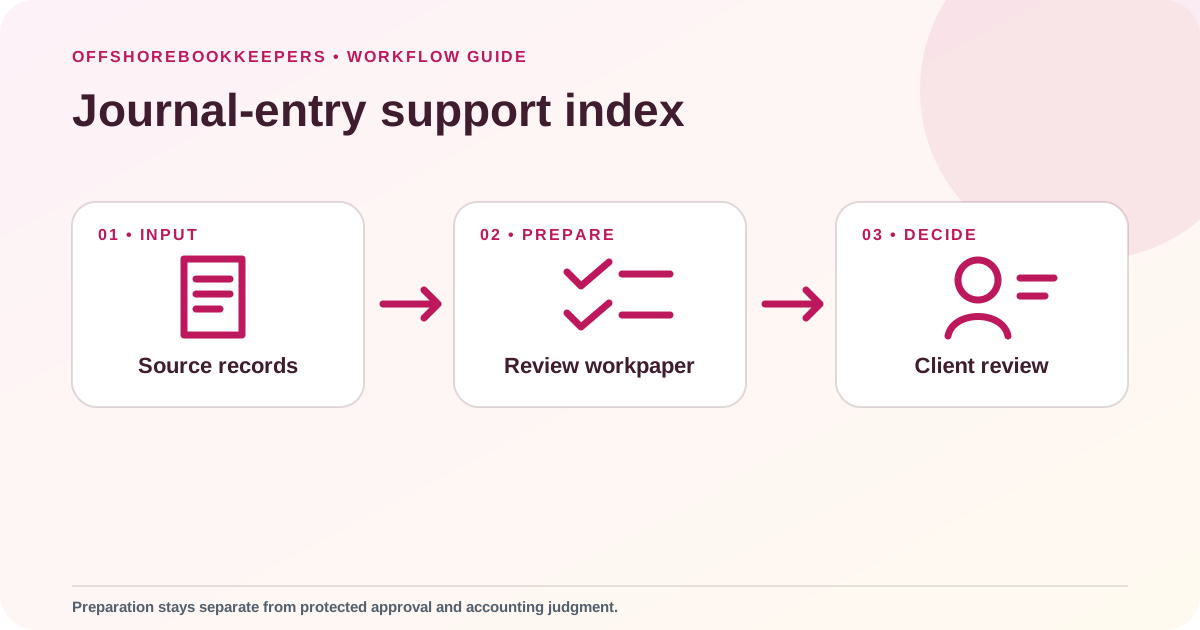
  • Preparation and indexing can be delegated; approval, accounting judgments, access rights, and exception resolution remain with authorized reviewers.

Design one record per journal

Assign an entry reference that does not change when a file is renamed. Capture the legal entity, ledger, period, journal date, posting date, source or journal type, preparer, approver, accounts, debit and credit totals, currency, purpose, status, and document links. Include batch and system journal identifiers so the line can be found in the general ledger.

A concise purpose explains the business event and why a manual entry is needed. “Month-end adjustment” is not enough. “Accrue the final week of contracted security service pending invoice” tells the reviewer what calculation and evidence to expect.

Match support to the entry’s assertion

Different entries require different evidence. An accrual may use a contract, service confirmation and estimate calculation. A reclassification needs the original transaction detail, correct destination and reason the first coding was wrong. A consolidation entry may rely on entity trial balances and an elimination schedule. A correction should identify the original entry without overwriting its history.

The support should agree with the journal’s entity, period, accounts, currency and amount. If a workbook contains several tabs, point to the relevant tab and version. Protect formulas or preserve an exported calculation so a later change cannot silently alter the approved basis.

Reconcile the index to the ledger

After posting, export the ledger population and compare it with the index. Check that every indexed “posted” journal exists, and that every in-scope ledger journal has an index record. Investigate duplicate references, gaps in sequence, journals dated in one period but posted in another, entries posted after the review cutoff, and debit-credit totals that changed between draft and posting.

Suppose an approved draft debits repairs and credits accrued expenses, but the posted entry debits equipment. The total still balances, yet the approval does not cover the changed classification. Mark it as changed after approval, retain both versions, and route the posted account choice back to the reviewer.

Make reversals traceable

For an entry intended to reverse, record the planned reversal date and method. Once reversed, add the actual ledger identifier and amount. Match full, partial and failed reversals separately. Do not mark an entry cleared simply because a journal with the opposite total exists; verify entity, accounts, reference and relationship.

A recurring accrual may reverse automatically and be replaced by an invoice. The index should connect the original accrual, reversal and settlement while showing any residual. This helps reveal duplicate expense recognition without assuming every residual is an error.

Preserve status and version history

Useful statuses include draft, submitted, approved, rejected, posted, reversed and superseded. Record dates and actors rather than replacing prior status evidence. If an entry is rejected, keep the reason and ensure it was not later posted under a different reference without review.

Store support in a location with appropriate access and retention controls. Links should resolve for the reviewer; local desktop paths and email-only approvals make the index fragile.

Keep responsibilities explicit

Bookkeeping support can create the index, collect evidence, test arithmetic, post within granted access, reconcile to the ledger and report exceptions. An authorized finance reviewer approves accounting treatment, period, unusual accounts, estimates, write-offs and corrections. System owners control posting permissions and workflow settings. The close pack should show unresolved entries and late changes rather than allowing completeness of the index to imply that every judgment is approved.

Questions owners ask

Should recurring system journals be in the same index?

They may be included, but identify their source and approval path separately from manual and non-routine entries so reviewers can select the relevant population.

What happens if a posted journal differs from the approved draft?

Retain both versions, identify the changed fields, and obtain review of the actual posted entry rather than treating the earlier approval as sufficient.

Keep planning