Offshore Bookkeepers guide

How to build a management reporting variance bridge

Reconcile period movements into evidence-linked drivers without confusing arithmetic, operational commentary, and accounting judgment.

Reconcile period movements into evidence-linked drivers without confusing arithmetic, operational commentary, and accounting judgment.

The short answer

  • Freeze the two report versions being compared and confirm they use the same scope, currency, and account mapping.
  • Make the bridge arithmetically reconcile: starting value plus separately supported drivers must equal the ending value.
  • Bookkeeping support can prepare data and trace explanations; management owns forecasts, operational causes, and decisions based on the report.

Lock the comparison first

Name the starting and ending report, entity scope, reporting period, currency, account hierarchy, and version timestamp. Confirm both reports use comparable definitions. A current month actual-to-budget comparison is different from current month to prior month, and neither should be quietly combined with year-to-date movement.

Retain the source exports. If the chart mapping, exchange rates or consolidation scope changed, quantify that effect before describing business performance. Otherwise, a reclassified account may be mislabeled as an operating increase.

Build a bridge that proves itself

The bridge equation is simple: starting value plus identified movements equals ending value. Use signed amounts consistently and include a visible unreconciled line rather than forcing a driver to absorb the residual. Tie the starting and ending values to the saved report versions and each driver to ledger detail or an operating report.

Separate drivers so they do not overlap. Volume, price, product mix, foreign exchange, acquisition or disposal, reclassification, timing and one-off items may be useful labels, but only when the evidence supports them. “Timing” should identify the transaction and expected recognition period; “volume” should connect to a reliable quantity measure.

Work from transactions to explanation

Begin with account and department detail, then group transactions that share a real cause. For payroll, compare approved payroll registers, headcount records and relevant accruals. For software expense, distinguish new subscriptions, seat changes, rate changes, credits and invoice timing. For revenue, reconcile financial totals to the appropriate sales or billing data before attributing movement to customers or products.

Imagine travel expense is higher than the prior period. Ledger detail may show one conference, a late invoice from an earlier trip and a credit in the comparison period. Those are three supported drivers, not a single claim that travel activity increased. Management may add business context, but the accounting bridge should retain the transaction-level basis.

Treat data and commentary as separate layers

For every driver, record amount, source link, preparer, explanation owner, status and review note. Mark whether the explanation is confirmed, awaiting operational input or based on an assumption. This prevents confident language from outrunning the evidence.

When non-finance owners provide commentary, preserve who supplied it and when. A sales manager can explain a campaign or customer event; bookkeeping support can test whether the amount agrees with the reports. Neither step independently proves causation.

Control versions through the reporting meeting

Give the bridge the same version identifier as the management pack. If a late journal changes the statement, do not overwrite the previous bridge. Save a new version, rerun the arithmetic, identify affected drivers and note whether management saw the earlier or revised figures.

Review for signs and units as well as totals. A favorable/unfavorable label can reverse meaning between revenue and expense. Quantities, percentages and currency should be clearly identified. If a percentage is used, name its denominator and comparison basis.

Set preparation and approval boundaries

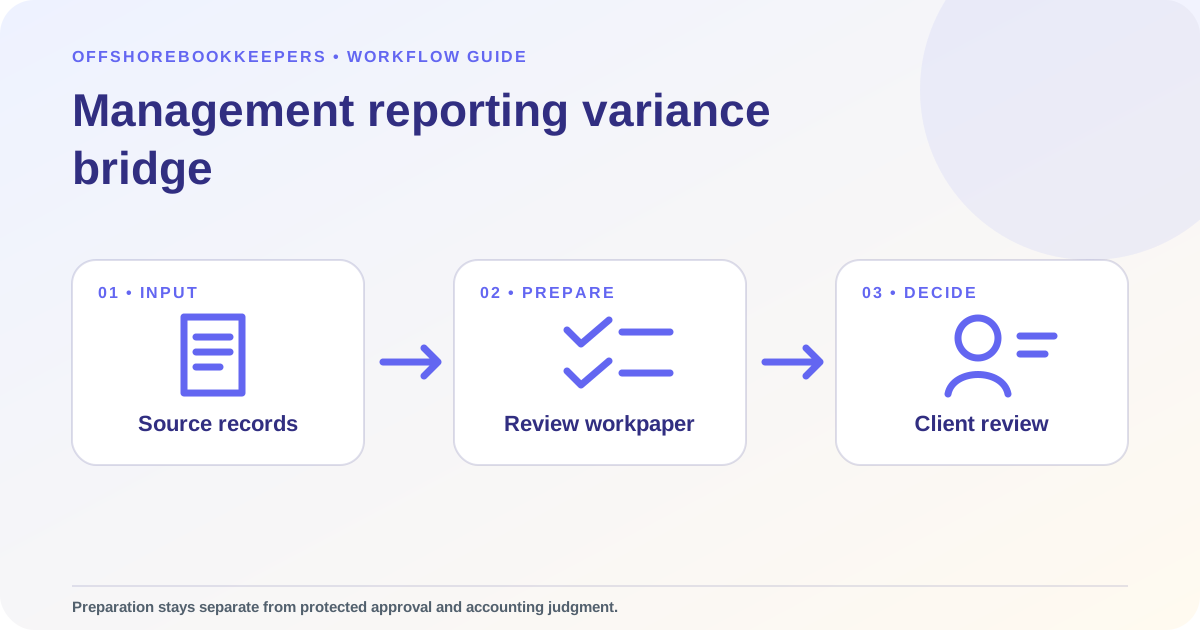
A bookkeeper can extract ledgers, normalize mapping, calculate movement, attach support and chase explanation owners. The controller or finance lead approves reporting definitions, materiality or review scope, accounting adjustments and final commentary. Operational leaders own statements about business causes and expected future effects. Forecast changes, targets and strategic actions belong to management, not to the preparer of the bridge.

The completed file should include frozen source reports, reconciliation checks, driver evidence, unresolved items, named commentary owners and final review. That produces a bridge that can be updated without rewriting history or guessing why a number moved.

Questions owners ask

What should a variance explanation contain?

State the comparison, amount, direction, supported driver, source, owner, and whether the item is recurring, timing-related, or still under investigation.

Can a bridge mix budget and prior-period comparisons?

Keep each baseline in a separate bridge or clearly separated column set. Mixing baselines can make driver totals appear to reconcile when they do not.

Keep planning