Offshore Bookkeepers guide

Month-end accrual evidence from estimate to settlement

Support month-end accruals with service-period evidence, a reproducible estimate, approval, reversal, and comparison to the eventual invoice.

Support month-end accruals with service-period evidence, a reproducible estimate, approval, reversal, and comparison to the eventual invoice.

The short answer

  • Document what was received by period-end, why no complete invoice is recorded, and how the estimate was calculated.
  • Link the accrual to its journal, reversal, invoice, and true-up so duplicate expense recognition is visible.
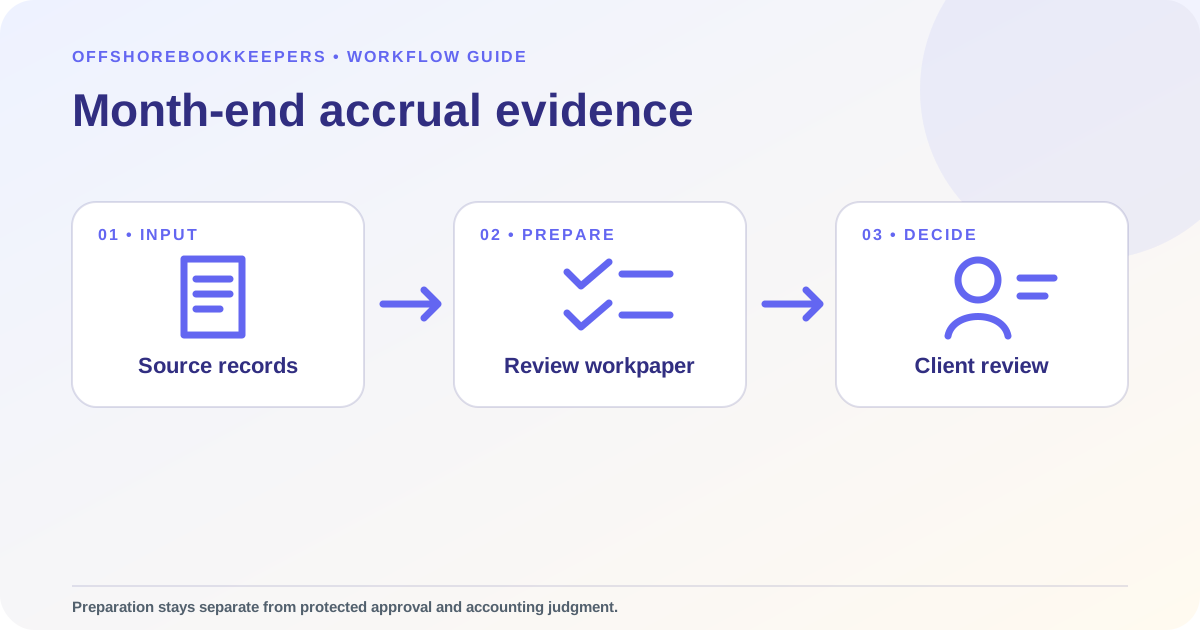
  • Bookkeeping support can prepare evidence and calculations under policy; the authorized finance reviewer approves assumptions, recognition, classification, and releases.

Start with the event, not the journal

Identify the vendor or payee, legal entity, nature of the good or service, service or delivery period, contract or purchase-order reference, cost center, currency and responsible business owner. Confirm that a complete invoice has not already been recorded. Then gather evidence of delivery or performance through period-end.

Relevant evidence depends on the item: approved timesheets for professional services, usage records for utilities or cloud services, receiving records for goods, payroll calendars and registers for earned compensation, or milestone acceptance for a project. A purchase order can support price and authorization, but it does not by itself prove receipt.

Use a reproducible estimate

Show the calculation at a level a reviewer can repeat. Use the strongest available current-period input, such as contracted rates multiplied by approved hours, units received multiplied by agreed prices, or metered usage. If current data is incomplete, document the alternative input, assumptions and known limitations.

Consider a maintenance contract billed after each quarter. At month-end, the schedule can cite the contract, service start and end dates, evidence that service continued, and the allocation method required by company policy. If the vendor paused work or added out-of-scope service, a straight-line estimate may no longer fit. Record the exception rather than adjusting the calculation without approval.

Keep taxes, discounts, credits, retainage and foreign currency visible when relevant. Do not mix multiple vendors or unrelated expense classes into one unsupported top-side amount merely because they share a department.

Prevent invoice and accrual duplication

Search accounts payable, purchase-order receipts, recurring journals and prior accruals before proposing a new entry. An uninvoiced receipt may already trigger an automated accrual. If so, reconcile to that process instead of posting a second manual estimate.

Give the accrual a unique reference and link it to the journal-entry index. Record expense and liability accounts, amount, period, preparer, reviewer, posting date, and intended reversal or release method. Where the policy uses automatic reversal, verify the actual reversal in the next ledger; scheduling it is not proof that it posted.

Compare with the eventual settlement

When the invoice arrives, match it to the accrual by vendor, service period and source reference. Show the original estimate, reversal or release, invoice amount and remaining difference. Explain whether the difference came from incomplete usage, a price change, additional service, currency movement, tax, incorrect scope or estimate error.

Suppose an invoice covers both the accrued month and the following month. Allocate it according to the approved policy before evaluating estimate accuracy. Comparing the full invoice with a one-month accrual would create a false variance. Likewise, a partial invoice should not automatically clear the entire balance.

Review stale and changing items

Roll forward opening accruals, additions, reversals, settlements, true-ups and ending balances. Age each open line by the original service period, not by the most recent reposting date. Ask for refreshed evidence when an estimate remains open, and keep disputed or canceled services distinct from ordinary invoice timing.

Changes to assumptions should be versioned. Preserve the prior calculation, state what changed and obtain review of the revised amount. Never overwrite evidence to make it resemble the eventual invoice.

Keep judgment with the right reviewer

Bookkeeping support can collect service confirmation, check calculations, identify duplicate exposure, prepare journals under policy and complete the settlement comparison. The controller or accountant approves whether recognition criteria are met, account classification, estimation methods, unusual assumptions, material corrections and release or write-off decisions. Business owners confirm operational facts; they do not replace accounting approval.

A complete close file includes the source evidence, calculation, journal, approval, reversal proof, invoice match, variance explanation and unresolved-item owner. That chain makes the estimate reviewable both at month-end and when cash or an invoice eventually settles it.

Questions owners ask

Is a purchase order enough support for an accrual?

Not by itself. It shows authorization or intent, but the file should also support what goods or services were received by period-end and how the recorded amount was estimated.

Should every accrual reverse automatically?

Follow the company’s approved policy. Whether an entry auto-reverses, is manually released, or remains until settlement should be documented and monitored to prevent duplicates or stale balances.

Keep planning