Offshore Bookkeepers guide

Project cost-code review

Keep project costs in the intended reporting buckets before close.

Keep project costs in the intended reporting buckets before close.

The short answer

  • Review project and cost-code combinations against source documents, project status, and an approved code dictionary before close.
  • Use targeted exception tests for blank, inactive, unusual, or inconsistent codes instead of manually rereading every transaction.
  • A bookkeeper can research miscoding and draft reallocations; project owners and finance reviewers should approve changes that affect budgets, billing, capitalization, or reported margin.

Start with a controlled code list

Maintain an approved dictionary showing each project, valid phase and cost code, plain-language definition, status, and responsible project owner. Include effective and closure dates so users do not keep posting to a completed job. If the accounting system supports valid combinations, document them; a cost code that is acceptable for one project may not be meaningful for another.

Avoid broad labels such as “other” unless the owner has defined when to use them. The review should not rely on a bookkeeper guessing from a short vendor description. Purchase orders, vendor bills, time records, expense reports, receiving records, and project instructions provide better evidence.

Run exception tests before reading detail

Export current-period transactions with transaction date, vendor or employee, document number, general-ledger account, amount, project, phase, cost code, and memo. Then isolate entries with:

  • a blank project or cost code where one is required;
  • an inactive, closed, or unknown project;
  • a project and phase combination outside the code dictionary;
  • the same invoice line assigned to multiple projects;
  • a vendor usually associated with one work type coded elsewhere;
  • costs posted after a project’s stated completion date;
  • credits that do not follow the original charge; or
  • material movement into catch-all codes near period-end.

These tests identify records requiring evidence; they do not prove that a transaction is wrong. Review the underlying document and ask the project owner when the commercial purpose is unclear.

Check labor and shared costs separately

Labor coding often comes from time records rather than invoices. Compare posted hours and payroll cost with approved time by employee, project, and period. Keep corrections at the level supported by the source; do not redistribute labor merely to make a project meet budget.

Shared purchases, freight, equipment, or overhead may require an allocation. The company should document the approved basis, such as direct usage or another supportable driver. A bookkeeper can apply that basis and preserve the calculation. A finance reviewer should approve a new method or an exception to the existing one.

Document every proposed reallocation

An adjustment log should show the original coding, proposed coding, amount, source link, reason, preparer, approver, and posting reference. Note whether the change affects customer billing, a project forecast, revenue recognition inputs, fixed assets, or inventory. Those consequences require the appropriate project and accounting review; correcting a code is not authority to change a contract or accounting policy.

After posting, rerun the project detail and confirm that the correction appears in both the project report and general ledger. Also confirm that the original amount was removed rather than duplicated. The final packet should include exception results, approved reallocations, unresolved questions, and control totals back to ledger detail.

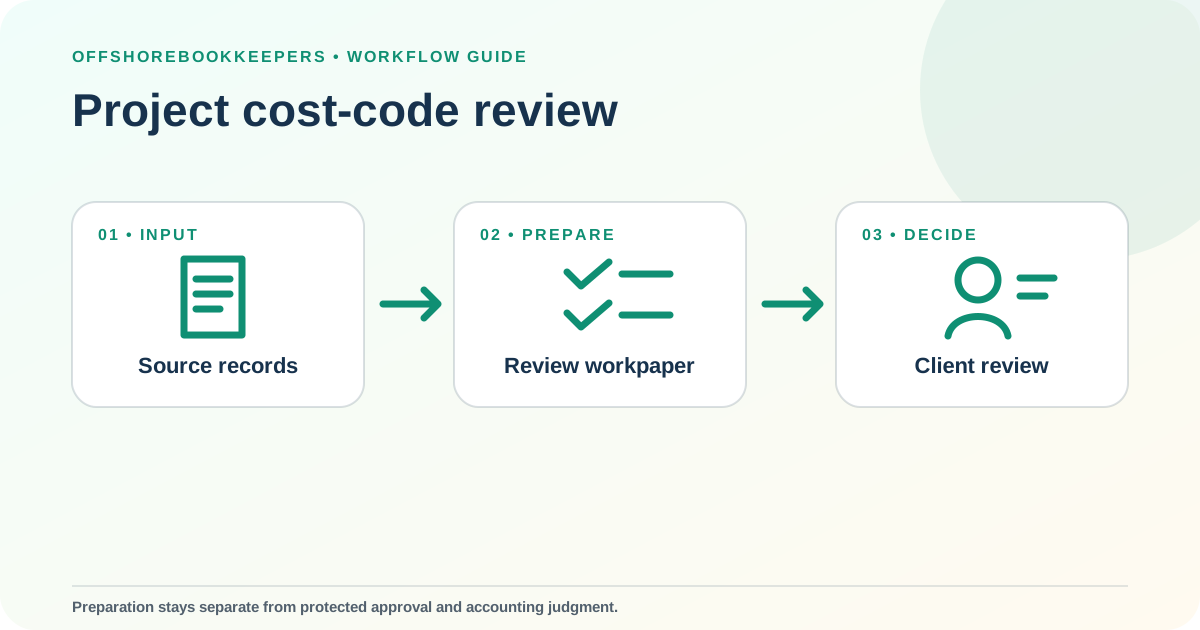
The bookkeeper can compile source records, run tests, prepare the log, and draft entries. Project owners validate operational coding, while an authorized controller or accountant approves reporting and policy decisions. IRS recordkeeping guidance offers general support for retaining transaction evidence. The monthly close support and reporting and review support pages provide adjacent workflow context.

Questions owners ask

What is the difference between an account and a cost code?

The general-ledger account describes the financial nature of a transaction, while a project or cost code assigns it to a job, phase, work type, or reporting bucket. A transaction may need both to be correct.

Can a bookkeeper reclassify project costs?

A bookkeeper may correct clear data-entry errors under an approved rule or prepare a proposed reallocation. Changes affecting project economics, customer billing, capitalization, or policy should be approved by the designated project or finance owner.

Keep planning

Sources

  1. Internal Revenue Service, Recordkeeping