
For an offshore bookkeeping handoff, which intervals can an owner measure reliably, and what do those intervals say about operating friction? This report treats the handoff as a sequence from request creation to evidence receipt to reviewer acceptance. It does not treat a staffing location as a performance explanation.
Bookkeeping Operations
Offshore bookkeeping handoff latency: what the evidence can measure
Research on the delay between a bookkeeping question, an evidence handoff, and a reviewable answer in a distributed finance team.
Published · 4 listed sources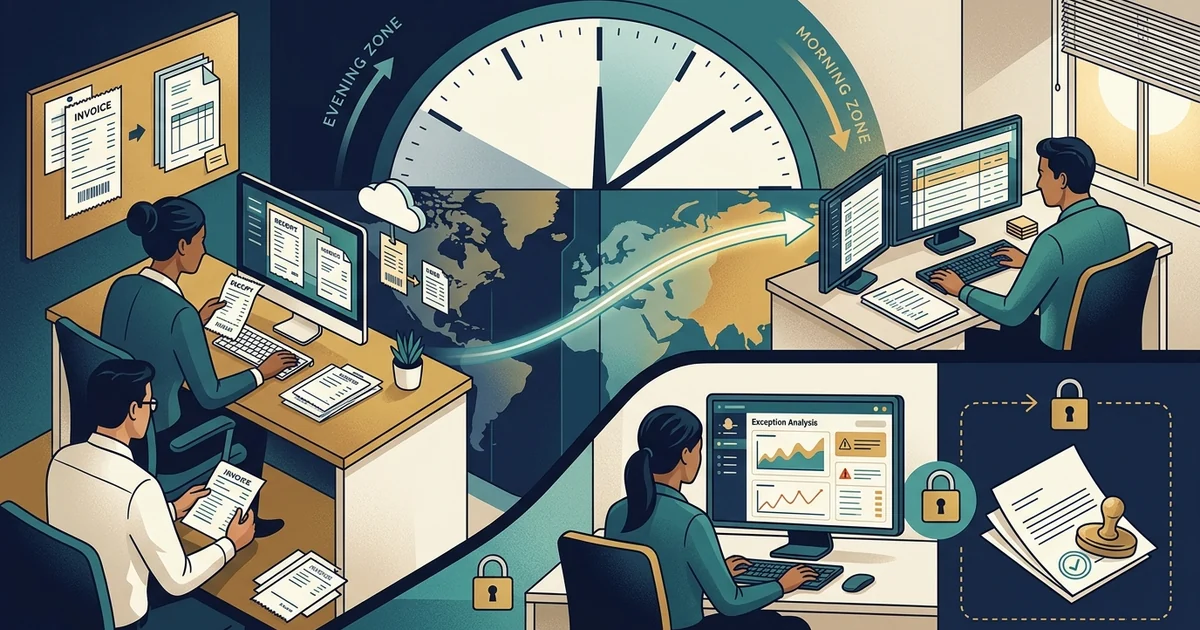
Key takeaways
- Handoff latency is a measured interval, not a synonym for total close time.
- A useful sample records requester, evidence state, owner, and business-hours convention.
- The evidence does not establish a universal response target for every company.
Research question
Evidence scope and method
The method is a synthesis of public internal-control, continuity, audit, and occupation sources, plus a proposed sample design for bookkeeping work. The public sources describe control objectives and role context. They do not publish a universal offshore bookkeeping latency benchmark. The proposed sample therefore measures a company's own queue rather than borrowing a number from an unrelated population.
What to record
For each sampled request, preserve timestamps for request received, clarification sent, evidence complete, preparer response, reviewer decision, and final posting where applicable. Also record the request type, whether the source document was attached, the responsible role, and the business-hours rule. A simple median can hide a small set of severe delays, so report median, upper-percentile, and unresolved counts separately.
Niche-specific interpretation
Bookkeeping support often crosses a client's day and a team's day. That makes elapsed time and staffed time different measures. An owner who compares them without a stated convention may blame time-zone overlap for a missing document or call a complete handoff slow because the reviewer was unavailable. A better interpretation separates waiting for a client, waiting for a reviewer, and work time under the preparer's control.
Boundaries and conclusion
This evidence does not prove that a Philippines-based or other offshore team is faster, slower, cheaper, or more accurate. It does support a narrow conclusion: a documented event sample makes handoff friction visible enough to investigate. OffshoreBookkeepers.com readers can use the sample when defining a bookkeeping role, but response targets should follow transaction risk, reviewer availability, and the client's close calendar.
Source notes
The sources establish continuity, control, audit, and occupation context. The measurement design is an operating recommendation, not a reported industry statistic.
Evidence map
These notes connect bounded statements on this page to the listed public sources. They do not turn operational interpretations into empirical findings.
- The source list includes NIST, Contingency Planning Guide as public guidance relevant to workflow design.
- U.S. GAO, Standards for Internal Control is listed to frame review questions about offshore bookkeeping handoff latency: what the evidence can measure.
- PCAOB AS 2201 provides context; this report does not treat that source as proof that a staffing model causes an outcome.