
What does “complete documentation” mean when an outsourced bookkeeper receives records from a client? The term is often used as a score without describing the evidence being tested. This report builds a narrower definition around identification, authorization, recording, and retrieval.
Bookkeeping Operations
Source-document completeness in outsourced bookkeeping
A research model for testing whether bookkeeping entries arrive with enough evidence for review, posting, and later retrieval.
Published · 4 listed sources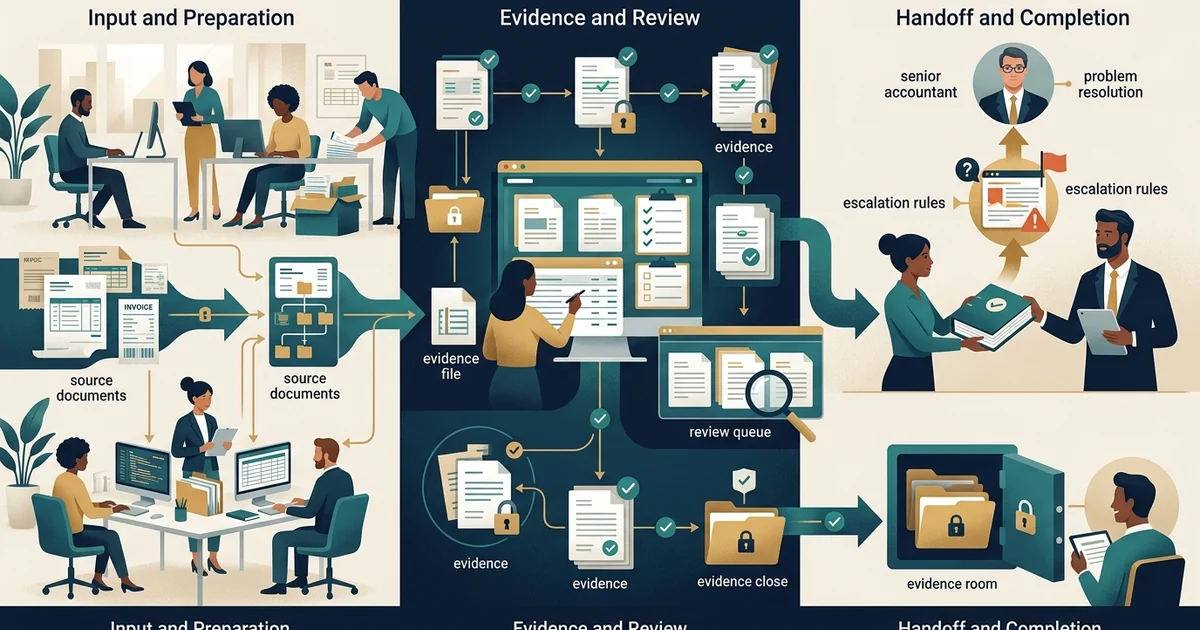
Key takeaways
- Completeness must be defined by transaction class and review purpose.
- Missing evidence and unusable evidence are different defects.
- A sampling plan is more informative than a single completeness percentage.
Research question
Methodology
The research compares public recordkeeping and internal-control guidance with a transaction-level sampling model. It does not estimate a market-wide completeness rate. A sample should be stratified by transaction class, such as bills, receipts, payroll journals, reimbursements, and manual entries. For each item, record whether evidence is present, readable, linked, dated, and sufficient for the assigned review.
Findings for bookkeeping operations
An invoice attached to the wrong vendor is present but not usable. A bank-feed line with no source may be explainable for a recurring charge, but that exception should be explicit. Payroll journals often need a source pack that ties totals to an approved payroll report. These examples show why one yes-or-no field can conceal different remediation work. A remote bookkeeping role should state which defects the preparer can resolve and which require client input.
Interpreting a result
Report the sample size and the definition before reporting a percentage. Separate missing records from records that fail to identify the transaction. Track repeat defects by source process, not only by bookkeeper. If the same evidence is missing every month, the result may point to an upstream intake problem rather than individual carelessness.
Limitations and conclusion
IRS recordkeeping guidance is not a universal retention or documentation rule for every jurisdiction, and audit standards do not turn a small-business bookkeeping sample into an audit. The evidence supports a bounded conclusion: outsourced bookkeeping quality is easier to review when completeness is defined per transaction class and tested with a traceable sample. It does not support a universal pass percentage.
Source notes
The public sources establish record and control principles. The sampling design is a proposed management measurement for finance teams.
Evidence map
These notes connect bounded statements on this page to the listed public sources. They do not turn operational interpretations into empirical findings.
- The source list includes IRS, Recordkeeping as public guidance relevant to workflow design.
- PCAOB AS 2201 is listed to frame review questions about source-document completeness in outsourced bookkeeping.
- U.S. GAO, Standards for Internal Control provides context; this report does not treat that source as proof that a staffing model causes an outcome.