
This study defines an evidence protocol for insurance-claim receivables. It reports no recovery rate, legal opinion, tax conclusion, or client outcome; authorized owners retain coverage, recognition, measurement, tax, and settlement decisions.
Close & Reporting
Insurance-claim receivables: evidence, uncertainty, and ledger reconciliation
A bounded research protocol for linking insured events, policy evidence, claim submissions, insurer decisions, recoveries, repairs, write-offs, and receivable balances.
Published · 5 listed sources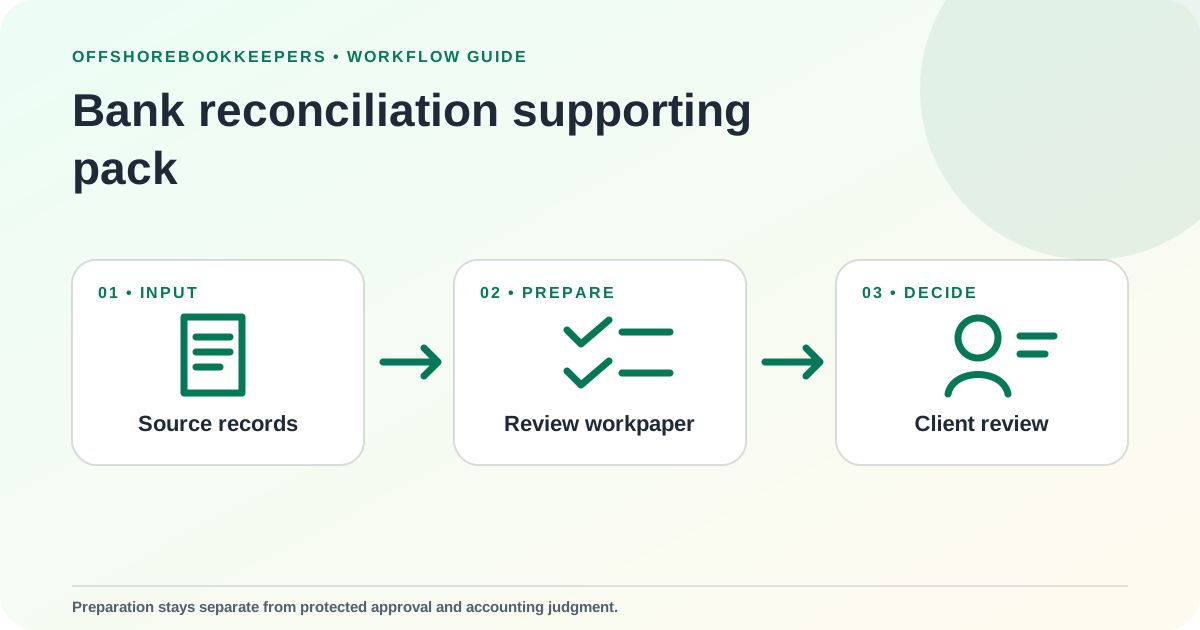
Key takeaways
- Keep the loss event, claim status, accounting conclusion, and cash recovery as separate linked records.
- Reconcile recognized receivables to case-level support and disclose submitted-but-unrecognized claims separately.
- Reserve coverage, probability, valuation, settlement, tax, and write-off judgments for qualified client owners.
Scope and decision boundary
Separate four stories that often get blended
An insured event produces at least four related stories: what happened to the asset or operation, what the policy and insurer say, what management records in the accounts, and what cash eventually arrives. These timelines rarely align. A repair invoice may precede a claim submission; an insurer may acknowledge a claim without accepting coverage; partial proceeds may arrive before final settlement; and management may change an estimate as evidence develops.
The study uses a claim case as the organizing unit while keeping those stories separate. Assign a stable case identifier and link event date, discovery date, affected asset or cost center, policy and coverage period, broker or insurer reference, submission, evidence requests, adjuster reports, insurer decisions, deductible, claimed amount, internally estimated recovery, recognized receivable, payments, expenses, asset entries, and approvals.
This structure prevents a common category error: treating operational claim status as an accounting conclusion. “Submitted,” “acknowledged,” and “under review” describe insurer workflow. They do not by themselves establish recognition or measurement. The authorized accounting owner records the conclusion and cites the evidence considered.
Create the event and policy inventory
Begin with event sources independent of the insurance schedule: incident logs, fixed-asset disposals or impairments, repair and remediation purchases, legal or risk registers, business-interruption records, and unusual expense accounts. Compare them with broker and insurer claim lists and the ledger. The union exposes events never evaluated for claims, claims absent from accounting schedules, and ledger balances without current cases.
Freeze source extracts with filters, period, time zone, row count, totals, extraction time, and hash. Include closed and denied cases so exclusion decisions can be tested. Preserve original policy documents and endorsements in effect at the event date. A current policy is not evidence of prior-period terms. Link amendments without replacing earlier versions.
Record the client-approved rule for grouping related events. A storm may affect several assets under one claim, while one equipment failure may implicate property, business interruption, and vendor warranty processes. Retain component identifiers even when a single insurer case spans them. Avoid duplicate receivables by mapping every recognized amount to the case and component.
Evidence gates without coverage interpretation
Define factual states: event identified, policy located, notice submitted, claim accepted for review, information requested, investigation active, partial decision received, approved, denied, disputed, paid, and administratively closed. Each state needs dated evidence. An email draft does not prove submission; a portal status without amount does not prove approval; a deposit with the insurer's name does not show allocation.
Create a separate accounting-state field: no entry, expense or loss recorded, asset accounting pending, recovery disclosure under review, receivable proposed, receivable recognized, estimate revised, cash applied, or write-off proposed. Require the decision owner, date, policy reference, journal identifier, and review. The bookkeeping team may populate facts and prepare proposed schedules, but it should not translate uncertain coverage into an accounting entry on its own.
Contradiction tests should flag recognized receivables without a current conclusion, paid cases with unapplied cash, closed claims with balances, payments exceeding recorded receivables, denied cases still carried, duplicate claim references, claims outside apparent policy dates, and journal entries lacking case identifiers. A flag prompts review; it is not proof of error.
Case roll-forward and cash allocation
Reconcile the receivable by case and currency. Opening recognized claim receivable, plus newly approved recognition and estimate increases, less estimate reductions and authorized write-offs, less cash applied, plus or minus approved currency effects, equals closing receivable. Tie the aggregate to the ledger and retain all reconciling items.
Cash allocations require more than payer and amount. Obtain remittance or settlement evidence identifying the case, coverage component, deductible, holdback, recoverable depreciation, fees, or other deductions. When one payment covers several components, use an approved allocation and preserve the unapplied remainder. Do not force the cash to equal the estimate by changing case values without authorization.
Maintain a second operational schedule for submitted or contemplated claims that management has not recognized. Keeping it outside the ledger roll-forward prevents accidental booking while allowing deadlines and evidence requests to be managed. Reconcile movement between operational and recognized populations through dated decisions.
Aging that respects claim stages
A single age from event date can mislead. Track event-to-notice, notice-to-insurer acknowledgment, request-to-response, decision-to-payment, payment-to-ledger application, and total elapsed time. Pause a clock only under an approved, observable rule and report paused cases separately. Show counts and amounts in bands and list the oldest consequential cases.
Age recognized receivables from the recognition or insurer-decision event selected by accounting policy, while retaining the event date. A young ledger balance may relate to an old incident. Cohort analysis by event month and recognition month reveals that delay. Reopened claims should keep their original history instead of resetting to zero.
Group exceptions by coverage type, insurer, policy, event type, location at an appropriate privacy level, currency, amount band, procedural state, and missing evidence. Differences cannot establish insurer behavior, employee fault, fraud, or control effectiveness. Catastrophe scale, policy complexity, adjuster availability, repair timing, and claim selection are confounders.
Offshore preparation and escalation
An offshore bookkeeper can maintain the case index, collect approved documents, link entries, update evidenced states, prepare roll-forwards, age requests, and assemble reviewer packets. Client management, risk, counsel, broker, tax adviser, and accounting owners retain coverage interpretation, claim assertions, negotiation, estimates, recognition, presentation, settlement acceptance, journal approval, and write-offs.
The daily handoff should identify new evidence, changed statuses, missing documents, approaching contractual or regulatory dates supplied by qualified owners, cash needing allocation, and decisions blocking close. Set overlap hours and a named escalation route. Insurance files may contain health, employee, customer, location, bank, and security information; limit copied fields, use approved storage, and grant least privilege.
Review procedure and limitations
The reviewer reconciles the event, insurer, and ledger populations; traces selected events forward and receivable balances backward; inspects all material estimates, denials, manual entries, old cases, duplicate references, unapplied receipts, write-offs, and status reversals; and confirms that recognized amounts have authorized conclusions. Review subsequent receipts as evidence without treating them as known at the earlier reporting date.
This protocol cannot establish coverage or the likelihood of collection. Policies may have exclusions, sublimits, deductibles, waiting periods, and legal interpretations not captured in a schedule. Insurer portals can overwrite history. Event populations may be incomplete. Later settlement does not validate every earlier estimate, and one entity's experience cannot produce a market benchmark.
Retain frozen event and claim populations, policy inventory, evidence index, accounting-decision log, case roll-forward, operational unrecognized schedule, cash allocation, aging, exception register, reviewer selections, corrections, and approvals. A sound conclusion states which populations were reconciled, what remains uncertain, who owns each decision, and how the closing ledger amount was derived.
Add a subsequent-evidence matrix for events near period end. For each selected case, list information available at the reporting cutoff separately from later insurer decisions, repair estimates, legal advice, and cash. Ask the accounting owner to identify whether later material confirms conditions already present or represents a new development under the applicable framework. The bookkeeper records the dated conclusion but does not backfill the earlier evidence column. This prevents hindsight from making an uncertain close appear more certain than it was and preserves a clear basis for any later adjustment.
Sources and checked dates
- FEMA National Flood Insurance Program forms and underwriting materials - FEMA; checked October 2, 2026.
- NAIC Consumer Insurance - National Association of Insurance Commissioners; checked October 2, 2026.
- PCAOB AS 1105 - PCAOB; checked October 2, 2026.
- IRS Publication 547 - IRS; checked October 2, 2026.
- IRS Publication 583 - IRS; checked October 2, 2026.
Evidence map
These notes connect bounded statements on this page to the listed public sources. They do not turn operational interpretations into empirical findings.
- FEMA and NAIC materials provide official insurance and claim context, but a business's policy, insurer communications, jurisdiction, and qualified advisers determine its rights and obligations.
- IRS Publication 547 addresses federal tax topics for casualty events and Publication 583 addresses records; neither determines financial-statement recognition.
- PCAOB AS 1105 informs evidence thinking in audit contexts; this operational protocol is not an audit procedure or assurance report.
Separate case preparation from coverage judgment
Define case identifiers, evidence gates, ledger mappings, decision owners, and review before assigning routine upkeep.
Discuss a controlled claim schedule