Reconciliation

Reconciliation exception taxonomies for offshore bookkeeping teams

A source-based review of whether consistent exception categories improve reconciliation review, including evidence, methodology, limitations, operating implications, and a bounded conclusion.

A source-based review of whether consistent exception categories improve reconciliation review, including evidence, methodology, limitations, operating implications, and a bounded conclusion.

Key takeaways

  • Classify the observable exception rather than guessing at motive or root cause.
  • Keep the source, test performed, owner, disposition, and closure evidence visible behind every label.
  • Evaluate category counts with workload denominators, recategorized items, reopened items, and record samples.

Research question and scope

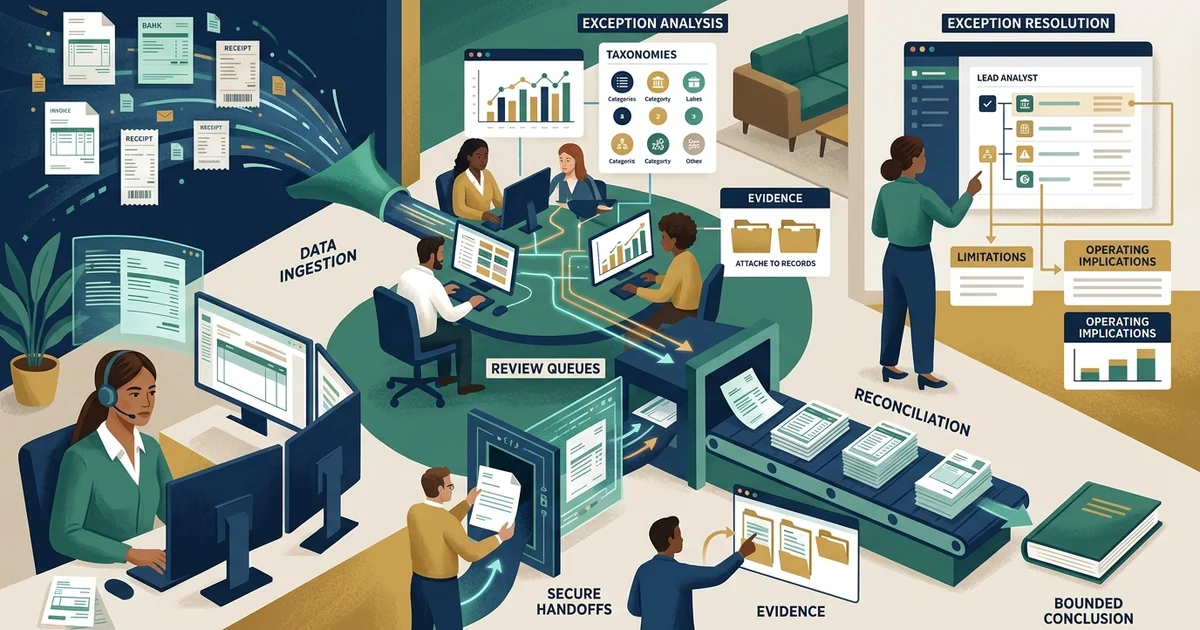
This review examines whether a consistent vocabulary can make reconciliation exceptions easier to route and review. It focuses on observable conditions in a bookkeeping record, such as missing evidence, timing differences, duplicate candidates, mapping questions, and owner decisions. It does not claim that one taxonomy improves accuracy or speed in every organization.

The unit of analysis is an exception moving from preparer to reviewer and, when needed, to a protected decision owner. Accounting treatment, materiality, write-offs, access changes, and final approval remain outside the preparer's independent authority.

Evidence base

The four listed materials address audit evidence, audit documentation, data integrity, and faithful representation from different institutional perspectives. They do not publish a shared reconciliation taxonomy or compare offshore bookkeeping teams.

This article uses them to frame what a reviewable record should preserve: the source, observed condition, test performed, current owner, proposed action, decision, and closure evidence. The category names that follow are local workflow suggestions.

What the sources support

PCAOB AS 1105 discusses the relevance and reliability of audit evidence and the use of company-produced information. AS 1215 addresses a reviewable record of procedures, evidence, conclusions, performers, reviewers, and dates. Those audit-context ideas support retaining the test and evidence behind an exception instead of storing only a label.

NIST defines data integrity in terms of guarding against improper alteration, while the IFRS Conceptual Framework discusses complete and neutral representation. Neither source authorizes a preparer to infer motive or root cause. Categories should describe what is observed and leave disputed causes and accounting decisions to accountable reviewers.

Operational interpretation

Begin with a small taxonomy tied to routing: source missing, timing difference, amount mismatch, duplicate candidate, mapping question, unauthorized change, reviewer question, and owner decision required. Each record should include the affected account, period, source links, test, amount if relevant, preparer note, current owner, due point, and closure evidence.

A label does not close an item or determine treatment. The preparer can classify the visible condition and assemble support; a reviewer confirms the category, approves corrections, and escalates policy, materiality, or access decisions. Local teams should split or retire labels only when actual records show that routing remains ambiguous.

Evidence and measurement

Track volume and disposition by observable category, but pair counts with sampled records. Useful checks include unclassified items, category changes, reopen rates, time waiting by owner, repeated source gaps, and exceptions closed without linked evidence. A rising count can reflect workload mix or better detection rather than worsening quality.

Trend review should preserve denominators and period definitions. Samples from common, rare, recategorized, and reopened groups can reveal whether labels are consistently applied. These measures guide investigation; they do not establish root cause on their own.

Methodology

The method was a qualitative comparison of four listed public sources with a generic reconciliation-review workflow. Concepts concerning evidence quality, attributable documentation, integrity, and faithful description were translated into fields a reviewer could inspect. No production ledger, vendor platform, survey, or controlled experiment was used.

Because the taxonomy is proposed rather than source-issued, the evidence map identifies only the concepts drawn from listed materials. Page dates document editorial publication and revision, not ongoing certification of the external links.

Limitations

The source contexts are cybersecurity terminology, financial-reporting concepts, and public-company audit standards. They do not apply uniformly to every business and do not test the proposed category set. The article also does not measure inter-rater agreement, correction rates, or financial-statement outcomes.

A useful taxonomy depends on the ledger, transaction types, close policy, reviewer skill, and obligations of the business. Professional judgment and required approvals cannot be replaced by a category menu.

Implementation test

Build a trial set of redacted or synthetic exceptions covering missing support, period timing, amount mismatch, duplicate risk, mapping ambiguity, and an owner-only decision. Give two reviewers the category definitions and ask each to choose the observed condition, evidence, next owner, and closure requirement.

Compare category agreement and, more importantly, whether both reviewers routed the item to the same authority. Rewrite labels that invite guessed causes or conceal multiple conditions. Keep live posting and approval rights unchanged during the exercise.

Conclusion

A concise observable-condition taxonomy can support routing and trend review when the underlying source, test, ownership, and closure evidence remain visible. The taxonomy proposed here is not a standard published by the cited organizations and has not been shown to improve outcomes across companies.

Use it as a starting hypothesis, test it on local records, and keep accounting judgments, correction approval, and final reconciliation sign-off with named client-side owners.

Source notes

The evidence map assigns AS 1105 to evidence quality, AS 1215 to attributable documentation, NIST to integrity terminology, and the IFRS Conceptual Framework to faithful depiction. None prescribes the proposed reconciliation labels or demonstrates that they improve outcomes.

Evidence map

These notes connect bounded statements on this page to the listed public sources. They do not turn operational interpretations into empirical findings.

  1. PCAOB AS 1105 discusses audit-evidence relevance and reliability and testing company-produced information for accuracy and completeness; it supports retaining the evidence and test behind an exception only as an audit-context analogy.
  2. PCAOB AS 1215 requires audit documentation to identify procedures, evidence, conclusions, performers, reviewers, and dates; it is the bounded basis for proposed attribution and closure fields, not for the category names.
  3. The NIST glossary defines data integrity as guarding against improper modification or destruction; it supports recording alteration concerns separately from amount, timing, or mapping exceptions.
  4. The IFRS Conceptual Framework's discussion of complete, neutral, and error-free depiction supports describing the observed condition faithfully; it does not establish root cause or prescribe a reconciliation taxonomy.

Listed sources

  1. PCAOB, AS 1105: Audit Evidence
  2. PCAOB, AS 1215: Audit Documentation
  3. NIST, Data Integrity glossary
  4. IFRS Foundation, Conceptual Framework for Financial Reporting

Related research