Bookkeeping Operations

Source-document freshness in offshore bookkeeping operations

A source-based review of how source timing and version control affect remote bookkeeping reliability, including evidence, methodology, limitations, operating implications, and a bounded conclusion.

A source-based review of how source timing and version control affect remote bookkeeping reliability, including evidence, methodology, limitations, operating implications, and a bounded conclusion.

Key takeaways

  • Judge freshness against the business event, covered period, and decision rather than file age alone.
  • Record effective time, provenance, version, and supersession so reviewers can identify conflicting sources.
  • Treat freshness, completeness, and integrity as separate review questions and escalate the choice of governing source.

Research question and scope

This review asks how a bookkeeping team can tell whether a source document is current enough for a specific event, period, and decision. Freshness is not treated as file age alone. A newly downloaded report can cover the wrong period, while an older contract may remain the governing source until it is amended.

The article focuses on effective time, covered period, version, supersession, provenance, and review use. It does not determine accounting treatment, retention law, or whether offshore work changes source reliability.

Evidence base

The four listed materials span audit evidence and documentation, financial-reporting timeliness, and data-integrity terminology. They do not define one source-freshness rule for bookkeeping operations.

The article draws limited concepts from each context: timeliness from the IFRS Conceptual Framework, evidence form and reliability from PCAOB AS 1105, attributable documentation changes from AS 1215, and integrity terminology from NIST. The proposed source register is a local operating interpretation.

What the sources support

The IFRS Conceptual Framework discusses timeliness as having information available in time to influence decisions. PCAOB AS 1105, within an audit, addresses how evidence source and form affect reliability. AS 1215 addresses a completed documentation record and identification of certain later additions. These concepts point to more than a latest-file label.

NIST defines data integrity around guarding information from improper alteration or destruction. That is not the same as business-period freshness. A source can retain integrity while being superseded, or be recent while lacking trustworthy provenance. The workflow should record both properties separately.

Operational interpretation

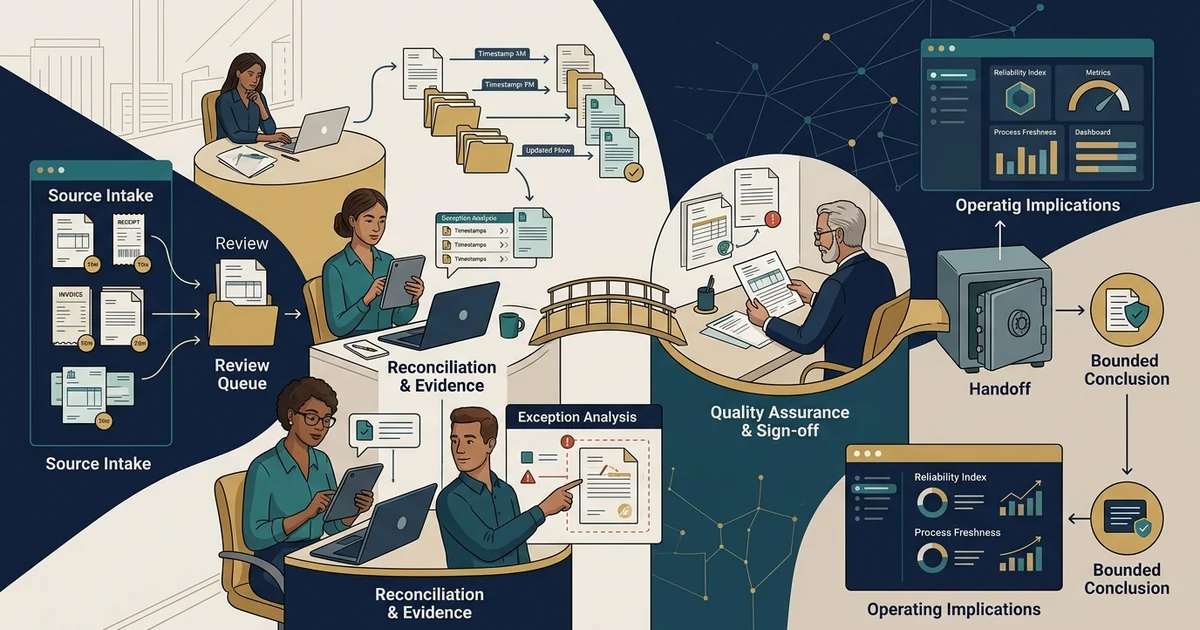
A source register can record document type, business event, covered period, effective time, received time, source system or owner, version identifier, superseded-by link, integrity or access concern, preparer use, reviewer decision, and retention location. The relevant freshness rule should be attached to the process, not guessed from the filename.

Preparers can flag missing periods, conflicting versions, or unclear effective dates. Authorized owners should decide which version governs, approve any override, and determine whether reports or entries must be revisited. The register does not replace those decisions.

Evidence and measurement

Measure source exceptions by type: wrong period, superseded version, missing effective date, untraceable export, late owner response, or post-review change. Include the population reviewed and sample records so a percentage has a clear denominator and context.

Track whether a later version changed the prepared result, whether the reviewer saw the effective-date issue, and whether superseded files remained accessible. These observations can reveal workflow gaps but cannot establish that location or staffing model caused them.

Methodology

The method was a qualitative mapping of four listed public materials to a generic source-document lifecycle. The review compared concepts relating to timeliness, evidence source, documentation changes, and integrity. It did not inspect client documents, compare software, or test financial-statement outcomes.

The evidence map identifies the exact URLs used for the central concepts and preserves their original contexts. Editorial dates on this page describe publication history only; they are not an external-link certification date.

Limitations

The sources serve different audiences and several may not govern a reader's organization. They do not define freshness thresholds for invoices, statements, contracts, payroll reports, or other bookkeeping records. The correct effective-date logic can also depend on accounting policy, law, tax rules, contracts, and system behavior.

Businesses should document source-specific rules with accountable advisers and owners. This article does not validate a particular document, determine retention requirements, or authorize a preparer to choose among conflicting records.

Implementation test

Use synthetic or properly redacted examples: a current-period statement, an old but still effective contract, a recent wrong-period export, two conflicting versions, a record changed after review, and a file with unclear provenance. Ask two reviewers to identify the governing period, version, integrity concern, next owner, and evidence needed for acceptance.

Compare disagreements and revise the source rule or metadata fields. Keep system administration, accounting judgment, and approval with existing owners. The exercise tests workflow clarity rather than compliance or source validity.

Conclusion

Source freshness should be defined against the business event and decision, with effective time, covered period, provenance, versions, and supersession visible. Freshness and integrity are related review questions but are not synonyms. This framework is a proposed operating design, not a standard issued by the listed organizations.

Test it on local document types and preserve accountable review when a version conflict could affect an entry, report, filing, payment, or other protected outcome.

Source notes

The evidence map assigns the IFRS Conceptual Framework to timeliness, AS 1105 to evidence source and form, AS 1215 to attributable later documentation changes, and NIST to integrity terminology. No source establishes a universal freshness threshold or validates the proposed source register.

Evidence map

These notes connect bounded statements on this page to the listed public sources. They do not turn operational interpretations into empirical findings.

  1. The IFRS Conceptual Framework describes timeliness as having information available in time to influence decisions; this supports evaluating availability against a decision, not treating download age as a universal freshness threshold.
  2. PCAOB AS 1105 explains, in an audit context, that evidence reliability depends on its source and nature and addresses testing company-produced information for accuracy and completeness; it supports recording provenance and review purpose without validating a bookkeeping source.
  3. PCAOB AS 1215 addresses completion of the audit documentation record and identification of specified later additions, including who added information and when; it is the bounded source for attributable version-change fields.
  4. The NIST glossary defines data integrity in terms of guarding against improper modification or destruction; it supports separating integrity from business-period freshness, completeness, and supersession.

Listed sources

  1. IFRS Foundation, Conceptual Framework for Financial Reporting
  2. PCAOB, AS 1105: Audit Evidence
  3. PCAOB, AS 1215: Audit Documentation
  4. NIST, Data Integrity glossary

Related research