Payroll & Tax

Payroll reconciliation evidence: source-to-payment and liability research guide

A U.S. federal-source method for reconciling payroll outputs to cash settlement, tax and deduction liabilities, and ledger clearing accounts.

A U.S. federal-source method for reconciling payroll outputs to cash settlement, tax and deduction liabilities, and ledger clearing accounts.

Key takeaways

  • Reconcile net-pay control totals to settled cash, not only to an initiated payment file or an approved journal.
  • Roll payroll taxes and deductions from opening liability through payroll additions, remittances, corrections, and closing balance by payee and due date.
  • Keep timing differences open with evidence and ownership; do not clear a payroll account merely because its net balance is zero.

Scope and research boundary

This guide covers reconciliation after payroll has been finalized: tracing payroll outputs to settled employee payments, remitted taxes and deductions, reported federal liabilities, and general ledger clearing or payable accounts. Its legal-source scope is U.S. federal employment tax reporting, correction, and recordkeeping. Payment evidence, benefit remittances, state and local taxes, wage garnishments, and accounting treatment also depend on contracts and rules outside that scope.

This is not a payroll calculation procedure and does not decide whether an employee, wage item, tax, deduction, or payment is legally correct. It assumes an authorized payroll output exists. The objective is narrower: prove what obligation the run created, what was paid or remains payable, what reached the ledger and federal returns, and how every difference will be resolved.

Reconciliation architecture

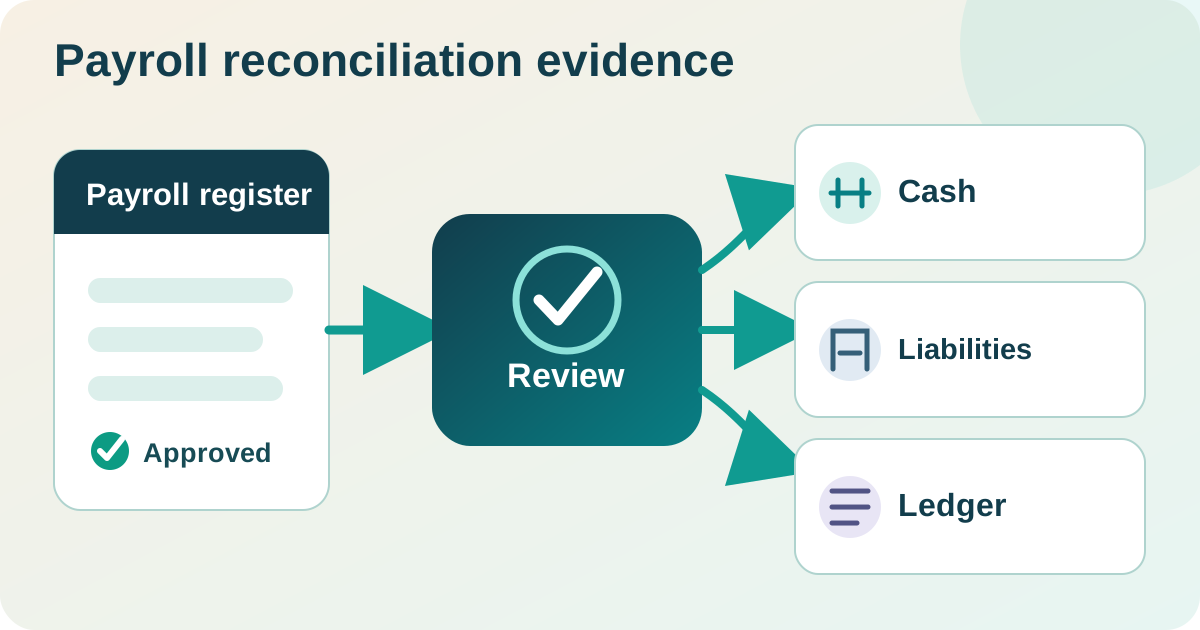
Use a payroll-run ID as the common key across the final register, payment or funding file, processor confirmation, bank settlement, tax-liability report, deduction report, journal, remittance evidence, and exception log. When a system does not carry that key, document the bridge using legal employer, pay date, amount, batch identifier, and transaction reference. Avoid matching only on amount because repeated payrolls and bundled debits can create false matches.

Maintain separate views for obligations and settlements. The obligation view begins with approved payroll outputs: net pay owed to employees, taxes payable by jurisdiction and tax type, deductions payable by payee, and employer payroll taxes. The settlement view records what cleared the bank or processor, when it settled, and which obligation it discharged. The ledger view shows whether those events posted to the correct legal entity, period, clearing account, and liability account.

Source-to-payment method

Step 1: Establish the population. List every regular, off-cycle, manual, voided, and reversed payroll run for the reconciliation period. Record the legal employer, payroll-run ID, pay-period dates, pay date, payment method, register version, expected net-pay amount, and expected funding date. Confirm completeness against the payroll-system run history rather than relying only on bank activity.

Step 2: Tie net pay to payment instructions. Compare the register's net-pay control total with the approved direct-deposit file, payroll processor funding notice, paper-check register, and other payment channels. Explain valid composition differences, such as separate fees or tax funding, rather than treating the processor's total debit as employee net pay.

Step 3: Prove settlement. Match each funding or payment batch to bank-posted transactions and available processor status reports. Capture settlement date, bank reference, amount, and final status. Returned direct deposits, stale checks, reversals, rejected batches, partial funding, and duplicate debits remain reconciling items. An initiation confirmation alone does not prove that recipients were paid.

Step 4: Reconcile the ledger. Tie register-derived net pay and liabilities to the posted payroll journal. Then tie bank settlement to credits to cash and reductions in payroll clearing or payable accounts under the employer's accounting policy. Reconcile opening balance plus payroll additions, less payments and approved adjustments, to the closing balance. Test gross debits and credits, not only whether the ending balance happens to be zero.

Liability and return method

Build a rollforward by legal employer, jurisdiction, payee, tax or deduction type, and due date. For each liability, show opening balance, current-payroll additions, remittances, refunds or reversals, approved corrections, and closing balance. Link each remittance to authorization, submission reference, settlement evidence, and the obligation periods it covers. Do not net one payee's overpayment against another payee's balance without documented authority.

For U.S. federal employment taxes, compare payroll tax reports and the general ledger with Form 941 categories and the period's deposit activity. Keep the tax-liability dates distinct from deposit dates; the Form 941 instructions expressly distinguish these concepts for Schedule B. Investigate amended payroll runs, fractions-of-cents adjustments, sick-pay reporting, third-party payer arrangements, and other supported reasons for differences.

At year-end, reconcile W-2 and W-3 totals to the applicable Forms 941 using the IRS instructions. Record each line or box compared, the amount on each source, and the reason for any legitimate difference. The reconciliation should be cumulative and should incorporate accepted corrections rather than merely compare the final quarter's figures.

Evidence fields and sign-off

The reconciliation header should include legal employer name and identifier, reconciliation period, payroll runs included, payroll and bank source systems, source extraction dates, report versions, currency, preparer, reviewer, preparation date, review date, and status. Record the journal IDs, bank-account token or approved account label, and return periods without exposing full employee bank or government identifiers.

For each settlement item, capture payroll-run ID, payment channel, expected amount and date, initiated amount and timestamp, authorization reference, settled amount and date, bank or processor reference, final status, ledger posting, and difference. For each liability item, capture payee and jurisdiction, liability type, opening balance, additions, remittances, adjustments, closing balance, due date, filing or payment reference, settlement date, and aging status.

Every reconciling item should have an ID, source and ledger amount, difference, cause if known, affected period, owner, next action, due date, risk or consequence, linked support, disposition, reviewer, and closure date. Sign-off should state the population reviewed, unresolved items, cutoff used for subsequent settlements, and whether the reviewer reperformed selected matches and rollforwards.

Review boundaries

A reconciliation preparer may collect read-only records, match batches, maintain liability rollforwards, and propose exception classifications. The preparer should not change employee payment instructions, alter payroll results, release funds, file a return, approve a remittance, write off a balance, or approve their own reconciling adjustment.

The payroll owner should validate payroll-run completeness and returned-payment treatment. Treasury or another authorized payment owner should validate bank settlement and release activity. The tax or compliance owner should approve filing positions, due dates, and correction paths. The accounting owner should approve journal adjustments and clearing-account disposition. The reviewer should be able to inspect source records independently of the preparer's annotations.

Where staffing prevents full segregation, disclose the incompatible duties and assign a compensating reviewer with independent bank, payroll, tax, and ledger visibility. The review must occur soon enough to stop or correct a duplicate, rejected, late, or misdirected payment; a later signature without reperformance is not a substitute.

Exception and correction workflow

Classify exceptions by layer: missing or revised payroll source, payment initiation difference, settlement failure, tax or deduction remittance difference, return-to-payroll difference, ledger posting error, cutoff timing item, or unsupported adjustment. Do not use a generic timing label without the expected settlement or filing date and the evidence that makes timing a credible cause.

First preserve the original records. Next quantify the difference and identify the legal employer, payroll runs, employees or payees affected, obligation date, and due date. Assign the issue to the owner who can correct that layer. Record any replacement payment, refund, void, amended payroll, adjusting journal, amended return, or agency correspondence. Close the item only after the corrective event has settled or been accepted and a reviewer has linked that result to the original exception.

For a federal Form 941 correction, use the current IRS instructions and retain the originally reported amount, corrected amount, difference, affected quarter, detailed explanation, approval, filing evidence, and any resulting payment, credit, refund, or correspondence. This guide does not determine whether a specific correction should use an adjustment or claim process.

Retention and limitations

Apply a record-class schedule, not a single payroll-folder date. The federal employment-tax period described in the evidence map does not override longer or different requirements for wage records, state and local taxes, benefit plans, garnishments, banking evidence, financial reporting, contracts, litigation holds, or unclaimed property. Processor access periods can also be shorter than the legal or business need, so export stable evidence before portal history expires.

The schedule should identify each record class, jurisdiction or authority, retention trigger, minimum period, owner, repository, access class, legal-hold override, and authorized disposal method. Protect employee-level data and retain only the detail needed to prove the reconciliation. Seek payroll, tax, employment-law, benefits, treasury, records-management, and accounting advice for obligations outside the cited U.S. federal sources.

How to use the evidence map

The evidence map associates every listed source with a bounded statement used here. The four-part operating model of obligation, settlement, ledger, and return is an applied reconciliation design. The cited IRS materials do not claim that this exact workflow prevents all payroll errors, nor does this guide offer an error-rate, timeliness, or staffing benchmark.

Evidence map

These notes connect bounded statements on this page to the listed public sources. They do not turn operational interpretations into empirical findings.

  1. IRS Publication 15 explains federal employment tax deposit obligations, including the monthly and semiweekly deposit schedules and electronic deposit requirements. A reconciliation therefore needs the employer's applicable obligation dates and actual deposit evidence, not just a quarter-end expense total.
  2. The Form 941 instructions distinguish total taxes after adjustments from deposits and refundable credits, then determine a balance due or overpayment. They also explain when Schedule B is used to report tax liability by day rather than deposit dates.
  3. The Instructions for Forms W-2 and W-3 direct employers to reconcile Form W-2 totals with the related Form 941 totals and explain that valid differences can arise for specified items. This supports a documented year-end cross-form reconciliation rather than an assumption that every box will match directly.
  4. The Form 941-X instructions require a detailed explanation of corrections and distinguish the adjusted employment tax return process from a claim for refund or abatement. A correction packet should therefore preserve the original amount, corrected amount, affected period, explanation, and filing path.
  5. The IRS says employment tax records should be retained for at least four years after filing the fourth quarter for the year and lists records such as deposit dates and amounts, returns filed, and adjustment information. That rule does not establish the retention period for every bank, benefit, state, or accounting record in the reconciliation packet.

Listed sources

  1. Internal Revenue Service, Publication 15 (Circular E), Employer's Tax Guide
  2. Internal Revenue Service, Instructions for Form 941
  3. Internal Revenue Service, Instructions for Forms W-2 and W-3
  4. Internal Revenue Service, Instructions for Form 941-X
  5. Internal Revenue Service, Employment Tax Recordkeeping

Related research