Offshore Bookkeepers guide

Deferred revenue rollforward: connect contracts, billing, cash, and releases

Maintain a deferred revenue schedule with source-linked additions, approved releases, adjustments, and ledger reconciliation.

Maintain a deferred revenue schedule with source-linked additions, approved releases, adjustments, and ledger reconciliation.

The short answer

  • Start with a frozen, source-linked population.
  • Separate preparation from policy and approval.
  • Keep every unresolved item visible with an owner and review date.

Why SaaS annual-deferred revenue needs its own workpaper

The records for SaaS annual-deferred revenue rarely arrive in one place or at one time. A reliable packet connects the executed order form, subscription roster, invoice, payment record, service dates, credit memo, cancellation log, deferred-revenue schedule, and general ledger. Posting the final bank amount alone removes the evidence needed to explain timing, fees, adjustments, ownership, and unresolved differences.

Authoritative background includes FASB revenue recognition resources and FTC business guidance. These sources inform the workflow but do not replace the company’s contract, accounting policy, jurisdiction-specific rules, or professional advice. Record the source version and access date when a changing rule affects the procedure.

Define the population and control totals

Define the legal entity, period, cutoff, currency, systems, accounts, locations, preparer, and reviewer before downloading records. Save untouched source exports with extraction timestamps, filters, row counts, and control totals. If a source can change later, retain a version or dated copy. A missing record stays visible as an exception; it is not a reason to estimate a convenient value.

Start with the last reviewed balance. Show additions, applications, reversals, transfers, refunds, corrections, and the closing position on separate lines. Compare the schedule independently with the relevant operational report, subledger, general ledger, provider statement, and bank movement. Net cash can agree even when customer, vendor, liability, revenue, or expense detail is wrong.

Use one row for each traceable event. Record stable identifiers, effective date, service period, gross amount, deductions, fees, taxes, reserves, refunds, currency, evidence link, status, owner, and due date. Do not combine unrelated items because they share a deposit date. Preserve original and corrected values in separate fields and leave formulas visible.

Work through a concrete example

A customer prepays $24,000 for twelve months beginning July 15. The billing system starts service on July 1, while the signed order and provisioning record support July 15. The rollforward preserves both dates and quantifies the disputed half-month rather than selecting a revenue start date.

The point is not to force the sources to agree. First reproduce each source’s arithmetic. Then compare the result with the approved contract or procedure. Finally show the ledger effect. Write exceptions as observed facts: one source reports a value, another reports a different value, and the difference is quantified. Possible causes belong in a separate note until evidence confirms them.

Set escalation thresholds under company policy, but do not use dollars as the only trigger. A small repeated error, an approaching dispute deadline, an access concern, altered payment details, or a missing approval may need immediate attention. Aging matters too: a modest item open for several months can reveal a broken handoff.

Keep preparation separate from judgment

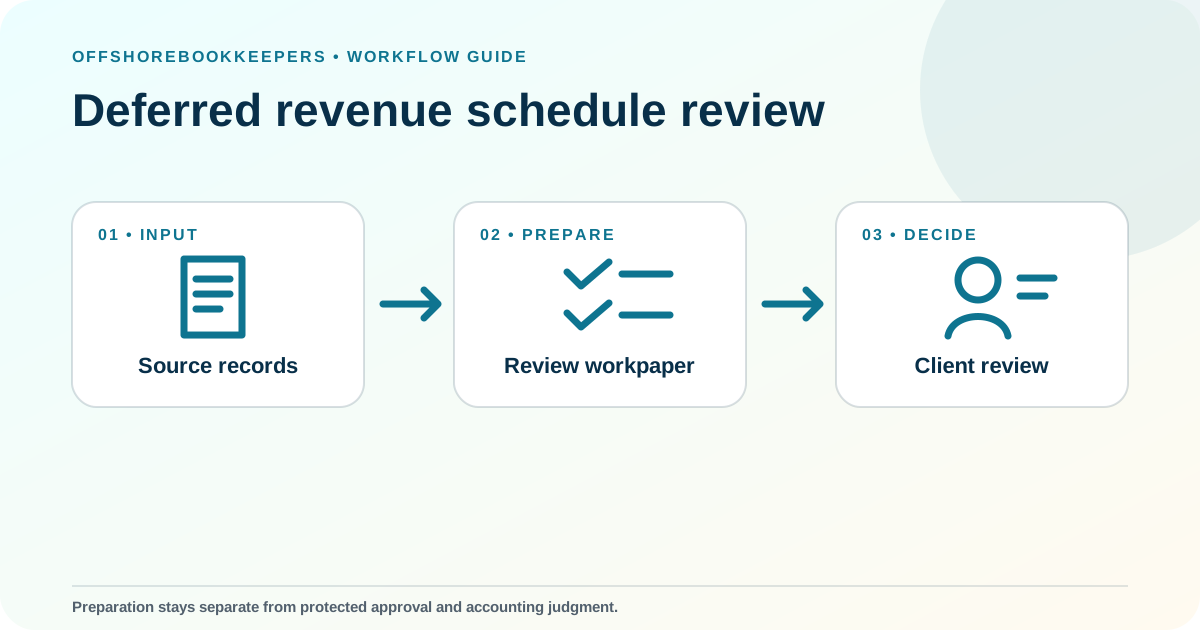
An offshore bookkeeper can download approved reports, compare identifiers and amounts, reperform arithmetic, request missing documents, update statuses, and draft an entry for review. The bookkeeper stops when the work requires contract enforceability, performance obligations, revenue-recognition policy, cancellation rights, credit approval, or accounting conclusions. That belongs to the revenue operations owner and controller.

Make the decision request answerable without rebuilding the file. Include the amount, affected period, deadline, source links, observed difference, available options, and operational consequence of delay. Store the response with the workpaper rather than relying on a private message.

Use exact statuses: ready to match, matched, timing item, missing evidence, amount mismatch, duplicate risk, policy question, awaiting approval, disputed, and closed with evidence. “Checking” is not useful unless it identifies the question, owner, and next date. Carry unresolved items forward with their original age and reference.

Protect access as carefully as the arithmetic. Use named accounts, multifactor authentication, and read-only or limited permissions where available. Separate preparation from payment release, bank-detail changes, credits, refunds, write-offs, journal posting, period locking, and deletion. Store sensitive evidence only in approved systems and mask identifiers when full details are unnecessary.

Review in both directions

Test completeness in both directions. Select source records and trace them into the workpaper; then select workpaper lines and trace them back to original evidence. Reperform large, unusual, manual, old, zero-value, and post-cutoff items. Equal and opposite entries still require review because they can conceal duplicates or misdirection.

The reviewer confirms the population, control totals, formulas, exception ownership, proposed entries, and judgment calls. Each review note needs a focused question, owner, date, response, and closure evidence. Preserve earlier answers when they change so the file explains how the final treatment was reached.

Track population count, matched and unmatched values, oldest exception, corrections returned, and percentage reviewed by deadline. These are workflow signals, not promises of financial performance. Repeated exceptions should lead to a better intake form, export, naming convention, or approval path.

Close without hiding open items

Close with untouched exports, reconciliation, evidence index, exception log, approved entries, reviewer decisions, and a concise summary. State what tied, what remains open, the value exposed, the next owner, and the next review date. Link the package from the close checklist using a consistent entity-process-period-version name.

For help defining the preparation lane, see the relevant Offshore Bookkeepers service. If your company needs a Philippines-based bookkeeper to maintain the schedule and route exceptions while your finance owner retains approval, plan the role with Offshore Bookkeepers.

Connect the work to the wider close

This register should not become an isolated spreadsheet. Link every completed item to the supporting packet and recorded transaction, then carry unresolved items into the next review with their original age intact. The team providing bookkeeping services can maintain the evidence and status trail. The client retains approvals, policy choices, and accounting judgments. Coordinate the final handoff with management reporting support so downstream reporting uses the reviewed population rather than an informal copy.

Questions owners ask

Can an offshore bookkeeper maintain this workflow?

Yes. The bookkeeper can gather evidence, update the register, calculate differences, and prepare questions under approved instructions.

Who owns exceptions and final approval?

The authorized client owner, controller, or adviser decides policy exceptions, accounting treatment, and final approval.

What should happen when sources conflict?

Preserve both records, describe the difference, and route a bounded question to the named owner.

Keep planning

Sources

  1. IRS, Recordkeeping